Separate recurring and one-time revenue
Setup fees can improve cash without improving recurring-revenue quality, so the model keeps them separate from subscription metrics and funding gates.
Loading case study
The route is preparing its narrative, media, and interaction state.
Tested scenario-planning application
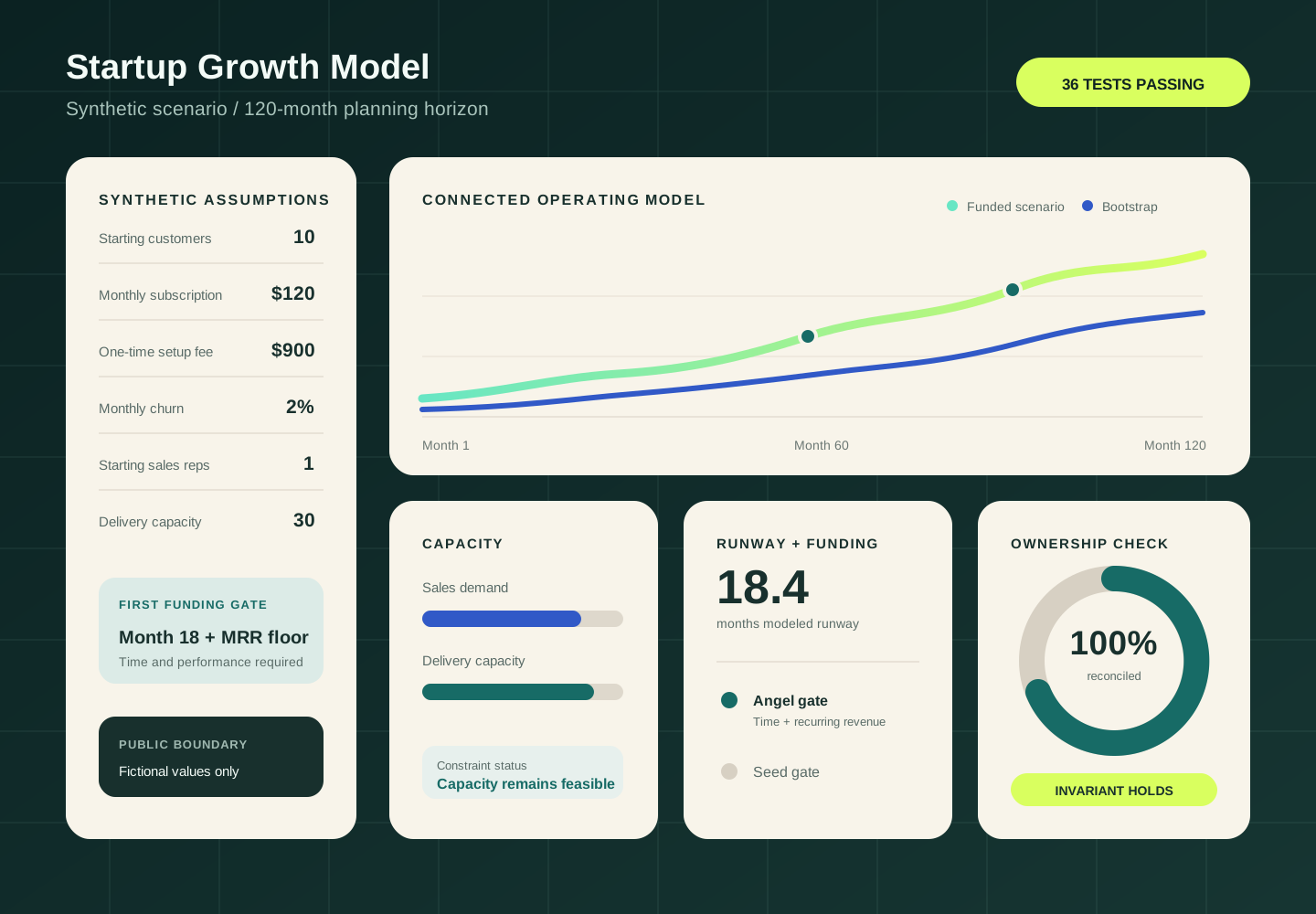
I built a deterministic planning application that connects recurring revenue, sales, delivery capacity, cash, runway, fundraising, and ownership across bootstrap and funded scenarios. A runnable, independently rewritten public engine uses synthetic inputs; the full application's operating assumptions and source remain private.
02 · The problem
Startup decisions rarely move independently. Pricing changes revenue, revenue changes hiring capacity, hiring changes runway, and fundraising changes both cash and ownership. The planning problem needed one consistent month-by-month model rather than a collection of disconnected spreadsheets.
03 · My role
I owned the model design, application architecture, interface, implementation, and verification strategy, translating operating questions into explicit parameters and testable financial and ownership invariants.
Translated operating questions into explicit parameters for recurring revenue, setup fees, churn, market limits, sales productivity, delivery capacity, payroll, and runway.
Separated the calculation layer from the interface so the same deterministic engine can drive browser charts and Node tests.
Modeled bootstrap and funded scenarios with the same engine, including timing and recurring-revenue gates for Angel, Seed, and Series A rounds.
Sequenced option-pool use and investor dilution so ownership reconciles to 100% after each event.
Designed charts, milestones, and comparisons around planning decisions while keeping all public examples synthetic.
04 · Key decisions
Each decision connects an interface behavior to a system or operating constraint.
Setup fees can improve cash without improving recurring-revenue quality, so the model keeps them separate from subscription metrics and funding gates.
Acquisition and customer delivery cannot scale independently forever. The model exposes when sales output exceeds onboarding and maintenance capacity.
A round requires both its planned month and a minimum recurring-revenue threshold, preventing capital from appearing automatically on a calendar date.
Option-pool use and round dilution are sequenced explicitly, and every ownership event must reconcile to 100%.
05 · Product experience
These product surfaces show the implemented workflow while keeping private source, customer data, and unfinished roadmap work out of the public site.
Define synthetic pricing, churn, staffing, capacity, and funding gates.
Use one DOM-free engine to calculate 120 connected monthly periods.
View bootstrap and funded results through the same operating logic.
Reconcile cash, funding order, capacity constraints, and ownership.
06 · System
One-time setup fees stay separate from recurring revenue so cash inflow does not distort subscription quality or funding gates.
Sales creates demand while delivery creates capacity, exposing the point where acquisition outpaces onboarding and maintenance.
07 · Verification and privacy
The runnable public engine uses synthetic values and a deliberately narrower, independently rewritten implementation. Actual company assumptions, forecasts, people, compensation, ownership, and the full application source remain private. The model is a deterministic planning tool, not financial advice or a probabilistic forecast.
The public repository includes a runnable synthetic engine, fictional scenario, command-line example, and 16 tests without publishing private inputs or the full application source.
Open the public case study (opens in a new tab)The simulation engine is DOM-free, allowing the browser interface and Node test runner to exercise the same formulas.
Open the system diagramThe private model currently passes all 36 Node tests covering financial reconciliation, operating constraints, funding events, and ownership invariants.
Review the verification scope08 · Result and current state
The application produces one internally consistent 120-month view of customers, revenue, staffing demand, payroll, cash, runway, funding eligibility, and ownership. Its calculation layer currently passes all 36 Node tests covering reconciliation, capacity, funding, and dilution behavior.
Continue the story
Product modeling, evidence aware AI boundaries, and testable proof of concept construction.